OpenJellyfish
Your expertise.An agent others can use.
An Agent workspace running on your computer.
Put your expertise into documents, connect Codex / Cursor, and take it from your own work to your team.

OPENJELLYFISH · 30-second brand film
Let your expertise go further.
Sound on. Keep the rally going.

Experience grows through use.
Begin with something you know. Let everyday work leave a method behind, then put it in someone else’s hands.
Daily work, revisions and shared services all draw on the same rules and knowledge.
See how documents guide behaviorGive the reason. Then the suggestion.
Check product facts against the brand handbook.
Connect every edit to the rule behind it.
Keep the writer’s intent as you refine the wording.
One piece of feedback becomes a starting point for the next task.
Your computer. Your account. An Agent your team can use.
Connect Codex / Cursor and carry the same documents through daily work, refinement and shared services.
Turn a brand handbook into a review habit.
Add a brand handbook and a draft to your workspace, then ask for review suggestions grounded in those materials.
Review this launch copy and explain the reason behind each suggestion.
The result
Check brand voice and product facts
Link each issue to the relevant rule
Suggest edits that can be compared with the original
Illustrative scenarios · Not customer data
Account-plan mode: macOS / Linux backend · Trusted internal members · Computer stays online and running
Get started



ONE KNOWLEDGE. MANY CONNECTIONS.
Give experience a form.
Let it travel further.
From a document on your desk to a conversation in someone’s hands. New entry points. The same accumulated methods and conventions.


01DAILY WORK
Start with your own day
Keep your materials close and give the task to your agent. Let the method grow through real work.



02LIVING DOCUMENTS
Keep what works
Feedback becomes rules. Revisions become versions. Every task leaves something to build on.


03SHARED EXPERIENCE
From your desk to theirs
Choose the documents and capabilities, then share the same expertise through WeChat, web or API.
OPENJELLYFISH ACADEMY
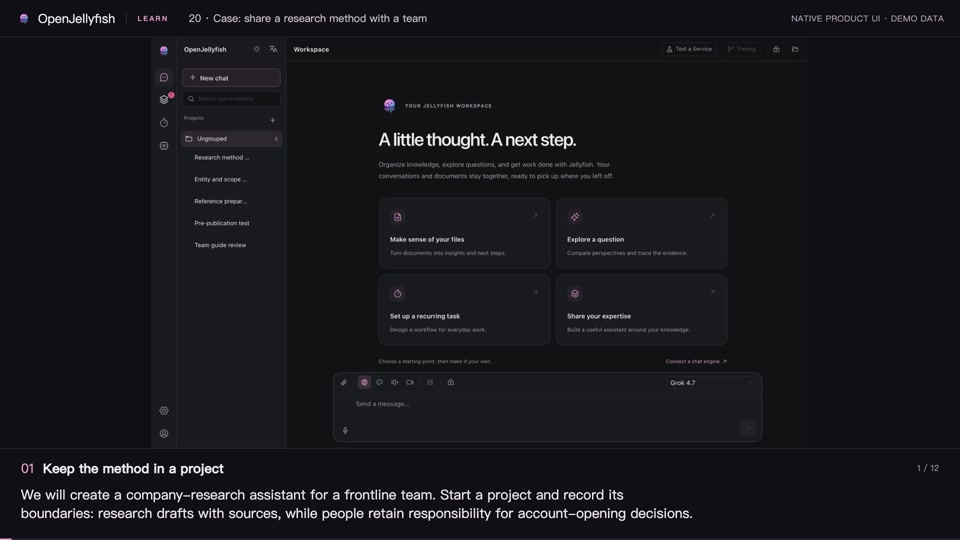
Learn by doing. Make your agent useful.
20 short lessons, from model connections and files to publishing a service. Available in English and Chinese.
Explore tutorials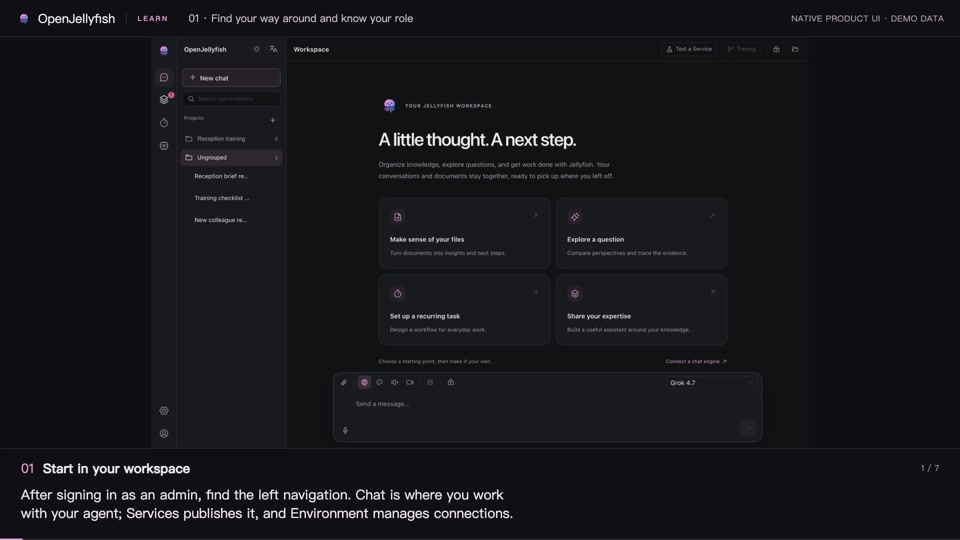
Start with your first agent.
Bring your documents, your existing account and one concrete task.
Your local agent workspace
Python & Node.js included · Install and authorize your CLI separately, or configure a model API
Apple M-series chips
Intel-based Mac
x64 · Model API mode
The Mac app is not Apple-notarized. First launch may require approval in Privacy & Security. Read the backup instructions before upgrading. Mac installation & upgrade guide
One step back. A little simpler.
Across different ways of working with agents, the jellyfish keeps things light: refine methods in documents, run locally, and share with a trusted team.


OpenClaw
Chat · Assistant
A self-hosted assistant connecting familiar chat channels to tools, skills, and your devices, for personal use or shared team deployments.
Hermes
Memory · Skills
An agent with persistent memory and reusable skills, available through terminals and chat channels for work that benefits from context across sessions.
OpenJellyfish
Light · Closed-loop
For small, trusted teams. Work beside your agent to refine documents and methods, then put a useful agent in someone else’s hands.
Flowise
Canvas · Agents
Connect models, knowledge, and tools on a visual canvas to build assistants and agent workflows, with tracing and evaluation for iteration.
n8n
Flow · Automation
Connect business applications, custom code, and AI steps into repeatable workflows that move information and actions across tools and systems.
Dify
Apps · Platform
Build agents, knowledge-powered chatbots, and workflows, then publish them as web applications or APIs for others to use.
Light, yet closed-loop. The jellyfish answer to 'simpler.'
Explore the products:OpenClawHermesOpenJellyfishFlowisen8nDify